
Passive House Design Calculator by Avenir Developments
The free Passive House Design Calculator by Avenir Developments help you determine steps you can use passive house design strategies.
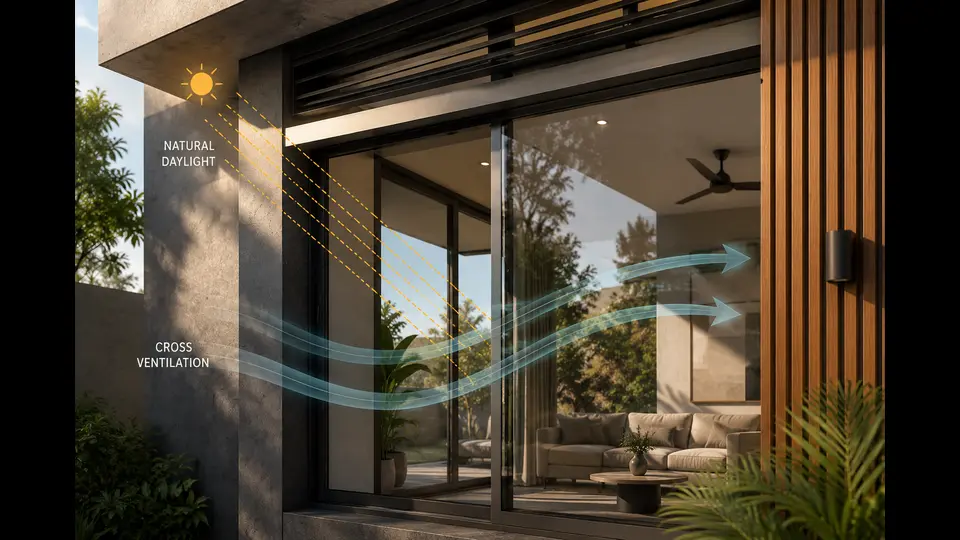
PASSIVE HOUSE BASICS
What the Passive House Design Calculator Helps You Estimate
Use this passive house design calculator to review insulation, glazing, solar gain, ventilation, and orientation choices before detailed design decisions are finalised for projects.
It gives homeowners, architects, and developers an early view of how passive house design principles can improve energy efficiency, indoor comfort, and building performance. By comparing envelope choices and room conditions, the calculator helps guide smarter design decisions from the start.
Passive House Design Calculator
Early-stage Passive House (PHI) readiness check. Estimate specific heating & cooling demand, heat-loss coefficients, and readiness vs. PH targets. Not a substitute for PHPP—ideal for concept decisions in Pakistan and worldwide.
Project Basics
Geometry & Envelope
Windows & Solar
Ventilation & Airtightness
Internal Gains & Solar Profile
Passive House Targets (quick view)
This tool is indicative. Certification requires full PHPP modelling and testing.
Method & assumptions (read me)
Heat loss: Transmission Σ(U·A) + ventilation (0.33·n·V). HRV reduces only the mechanical portion by its sensible efficiency; infiltration from n50×exposure remains unrecovered.
Solar gains: Window area × SHGC × vision fraction × orientation irradiance × shading × utilization (0.6). Cooling uses “Cooling Solar Fraction”.
Cooling: Approximate: Gains − (heat-loss at CDD), with night-ventilation relief. Results guide early design; not a substitute for PHPP or local energy codes.
ENERGY PERFORMANCE INPUTS
Key Passive House Inputs for Better Thermal Performance
A strong passive house strategy balances airtightness, thermal bridge control, shading, window performance, and fresh air systems to reduce heating and cooling demand substantially.
Key passive house metrics include insulation levels, window-to-wall balance, shading depth, ventilation with heat recovery, and airtight detailing. Optimising these inputs can lower peak cooling loads, reduce heat gain, and support more efficient, climate-responsive architecture.
GET YOUR PERSONAL PROJECT PLAN IN MINUTES
Contact Avenir Developments for our Passive House Design Services
- Architecture Services
- Interior Design Services
- Construction Services
- Design + Build Services
FOR PAKISTAN PROJECTS
Why Passive House Design Matters for Modern Homes in Pakistan
For homes in Lahore, Islamabad, and similar climates, passive house planning supports lower utility bills, better comfort, healthier interiors, and long-term value for owners.
For Pakistan, a passive house design calculator is useful for planning high-performance homes that respond to sun exposure, airflow, and material selection. It supports sustainable house design, lower operational costs, and better year-round living conditions for modern residential projects.