A few months ago an overseas Pakistani from Manchester called us the day he landed in Lahore. He had not seen his plot in almost a year. From the outside, his 1 kanal house in DHA looked finished, and the WhatsApp photos had always looked fine. Then he walked inside. The floor levels were off, seepage had crept up the basement wall, the electrical points did not match the furniture plan, and the contractor was already asking for more money.
That story is painful, and it is common. Building a house in Pakistan from abroad is not about sending money and asking a relative to “keep an eye”. Time zones, trust, moving material prices, society approvals, weak site supervision and family pressure all pull in different directions at once. Whether your plot is in DHA Lahore, DHA Islamabad, Bahria Town, Lake City or a CDA/LDA/RDA scheme, a remote build needs a system, not guesswork.
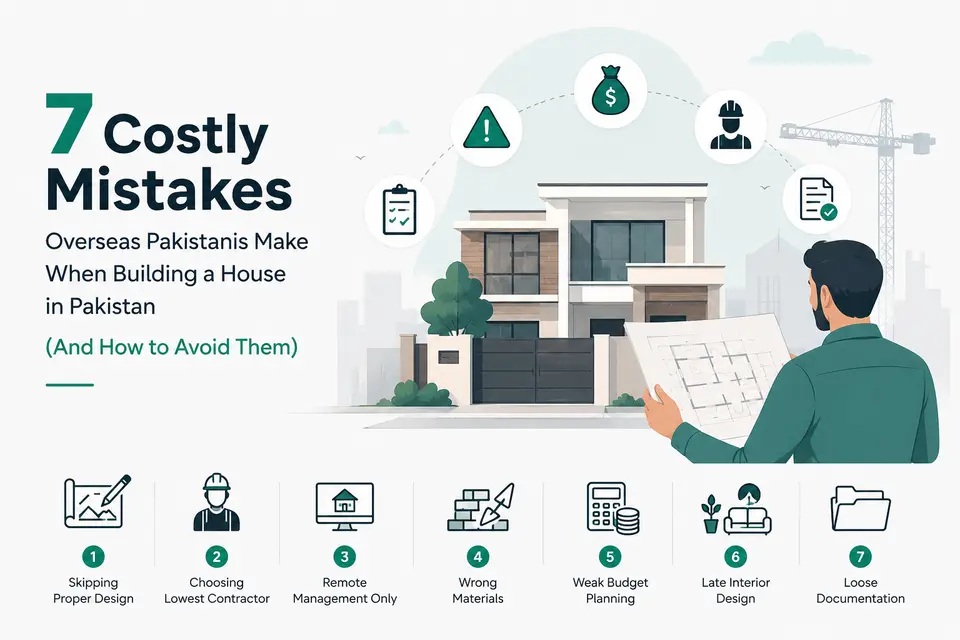
Most of these mistakes are avoidable. The trouble is that they look small at the start and turn expensive once concrete, plaster, tile and woodwork have gone in. Below are the seven I would warn a close friend about before they begin — written from what we actually see on overseas projects, not from a template.
Quick answer for overseas owners: The safest way to build from abroad is to lock the sequence before any money moves: finalise architectural design and society approvals first, price the work against a written BOQ, choose a contractor or design-build team on proof rather than the lowest rate, run independent technical supervision with weekly reporting, plan interiors early, and release each payment only against verified, measured progress. Cheap construction without drawings is usually expensive construction in disguise.
The difference between a stressful remote build and a controlled house project in Pakistan
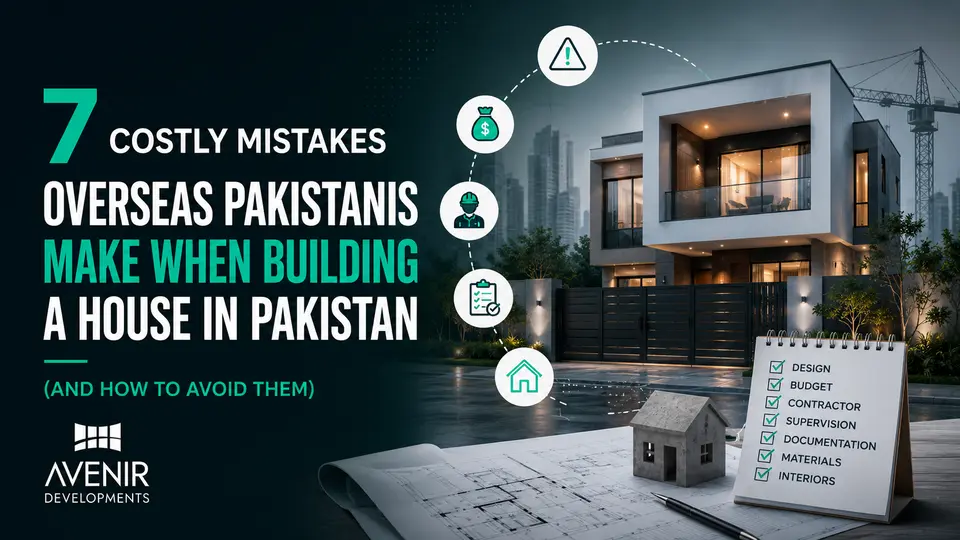
Most expensive mistakes happen before construction looks wrong on site. Use this visual checklist to understand what can go wrong, what it can cost you, and how to build with a safer system from abroad.
01 Skipping professional design and approvals +
02 Choosing the lowest contractor +
03 Managing the site remotely without technical supervision +
04 Using materials that do not suit Pakistan’s climate +
05 Underestimating budget and hidden costs +
06 Starting interior design too late +
07 Keeping weak legal and society documentation +
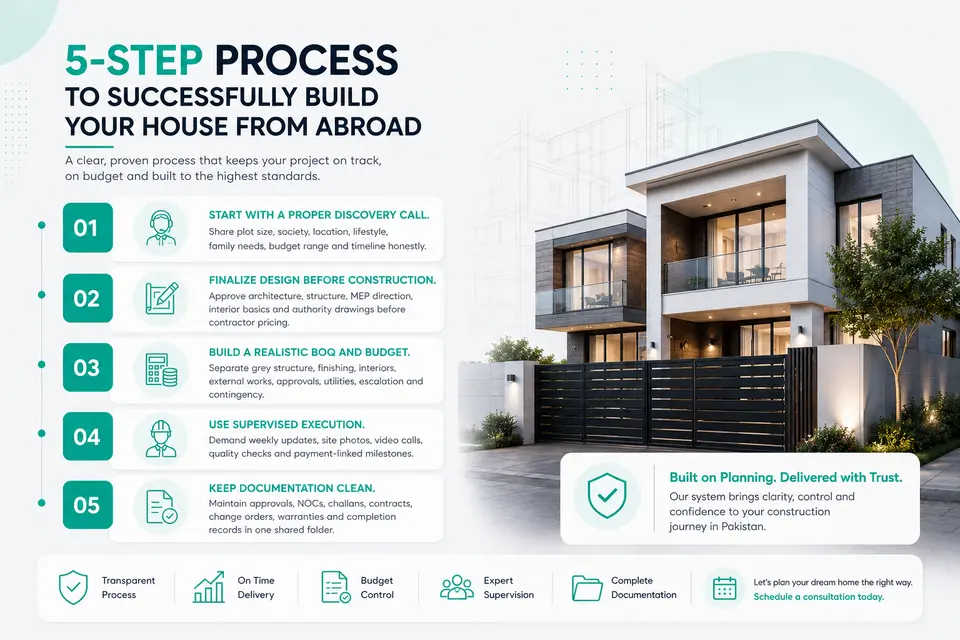
5-step safe build process
Use this as the practical route before starting construction from abroad.
Planning a house in DHA Lahore, DHA Islamabad, Bahria Town, Lake City, Park View City or another approved society?
Discuss on WhatsAppQuick Answer for Overseas Pakistanis
The safest way to build from abroad is to finalize architectural design, approvals, structure, BOQ, contractor selection, supervision, interior planning and payment control before work starts. Cheap construction without drawings is usually expensive construction in disguise.
At-a-Glance Risk Table
| Mistake | Risk | Safer Move |
|---|---|---|
| Skipping proper design | Revisions, approval delays, poor layout | Hire a DHA/CDA/LDA-aware architect first |
| Choosing lowest contractor | Material shortcuts and payment disputes | Verify past work, BOQ and contract terms |
| Remote management only | Wrong execution hidden until late | Use professional project supervision for remote or overseas builds |
| Wrong materials | Seepage, heat, cracks and maintenance | Select materials for Pakistani climate and soil |
| Weak budget planning | Cash shocks after grey structure | Plan grey, finishing, taxes, utilities and contingencies |
| Late interior design | Bad lighting, AC, wardrobes and kitchen flow | Start interiors before MEP and slab work |
| Loose documentation | Fines, resale issues and transfer delays | Maintain approvals, NOCs, drawings and completion records |
1. Skipping professional design and approvals
This is the most common error: someone abroad buys a plot, asks a draftsman for a quick map, and starts calling contractors. It feels fast. It is actually the slowest route, because a weak plan creates rework once walls are up.
A good architect does far more than an elevation. The value is in space planning, structural coordination, ventilation and sunlight, parking, staircase logic, services shafts, society byelaws and the approval drawings themselves. In DHA, Bahria, CDA and LDA-controlled areas, drawings and scrutiny are formal steps with real timelines — treat them lightly and you can lose weeks before the first brick is laid.
Safer move: appoint an experienced architect before any contractor conversation. Fix the layout, elevation direction, covered area, authority requirements and structural drawings up front. For a 1 kanal plot in particular, sound 1 kanal house design usually saves more through planning than it costs in fees.
2. Choosing Cheap or Unverified Contractors
Every overseas client hears this line: “Sir, main market se sasta karwa doon ga.” Be careful. In construction, cheap is rarely cheap. It often means weak supervision, poor shuttering, watered concrete, low-grade plumbing, unrecorded changes, and labour that disappears after payment.
The reason NRPs fall into this trap is simple. You are not on site daily, and the cheapest quote looks comforting when converted into pounds, dollars, dirhams or riyals. But a reliable contractor Pakistan project needs written scope, material specifications, payment milestones, site records and accountability.
How to avoid it: never compare contractors only on per square foot rate. Compare drawings, BOQ, brands, steel grade, concrete method, waterproofing, MEP scope, timeline, retention, warranty and previous projects. Whether you need Bahria Town construction services, luxury home builders Lahore, or the best construction company Islamabad shortlist, ask for proof, not promises.
3. Trying to Manage Everything Remotely Without Expert Supervision
Family supervision is helpful, but it is not the same as technical supervision. Your brother, cousin or chacha may visit the site, take photos and scold the mason. But can he check steel spacing, slab level, concrete honeycombing, waterproofing laps, plumbing pressure lines or electrical load planning? Usually not.
This is one of the biggest mistakes building house Pakistan clients make. Site teams learn quickly when the real decision-maker is abroad. Small shortcuts happen quietly. By the time you visit, the work is covered with plaster, tiles or paint.
How to avoid it: set up project supervision from abroad with weekly photo reports, video walkthroughs, BOQ tracking, site meeting minutes and payment approval gates. Do not release major payments only because “kaam chal raha hai”. Release against measurable progress, quality checks and verified quantities.
4. Making Wrong Material Choices for Pakistan’s Climate and Soil
A house in Lahore or Islamabad is not built for Instagram only. It faces heat, dust, monsoon rain, soil movement, water pressure, termites, humidity, load shedding patterns and hard water. Wrong material selection Pakistani climate decisions can punish you for years.
Imported tiles may look beautiful but become slippery in outdoor areas. Cheap waterproofing saves a little today and creates seepage tomorrow. Poor aluminium sections allow heat and dust. Weak plumbing fittings fail inside walls. Bad wood selection swells in humid rooms. Basements need special attention because soil, water table and drainage conditions vary society to society.
How to avoid it: choose materials through performance first, beauty second. Ask your architect, interior designer Bahria Town consultant, and construction team to specify waterproofing, insulation, glass, flooring, paint, plumbing, electrical, woodwork and external finishes according to local exposure. A luxury finish is useless if it cannot survive Pakistani conditions.
5. Underestimating Budget and Hidden Costs
Most overseas Pakistanis ask one question first: “Per square foot rate kya hai?” It is a fair question, but incomplete. The rate changes with covered area, basement, soil, elevation complexity, structure, finishing level, imported fixtures, wardrobes, kitchen, boundary wall, external works, utility connections and authority charges.
As of mid-2026, realistic planning bands for quality homes in Lahore and Islamabad are not the same as old YouTube rates. Grey structure vs turnkey must be understood clearly. Grey structure may cover foundations, RCC, brickwork, plaster and basic conduits. Turnkey construction Pakistan usually includes finishing, flooring, paint, doors, kitchen, baths, electrical fixtures, plumbing fixtures and sometimes wardrobes or landscaping, depending on contract scope.
How to avoid it: ask for a design-based estimate, not a random rate. Keep a contingency. Freeze specifications before finishing starts. And please, do not compare a basic grey structure quote with a premium turnkey construction Pakistan quote. They are different animals.
6. Delaying or Ignoring Interior Design Planning
Many clients say, “Interior baad mein dekh lein gay.” This sounds practical, but it often creates expensive rework. Interior design is not only sofas and wall panels. It affects electrical points, AC positions, false ceiling, lighting, plumbing, kitchen planning, wardrobe depths, bathroom niches, feature walls, smart home wiring and even window placement.
If interior design starts after plaster, the team may need to break walls for switches, move plumbing, add ceiling drops, change door sizes or compromise furniture placement. That is money wasted and finish quality disturbed.
How to avoid it: start interior planning during architectural design. Even if you do not finalize every fabric, decide furniture layouts, kitchen flow, bathroom vanity sizes, lighting zones and storage. For overseas Pakistanis building home for family visits, rental, retirement or resale, this one step improves daily comfort and long-term value.
7. Weak Handling of Legal and Society Documentation Issues
In Pakistan, the file is as important as the site. Ownership papers, possession, allotment or transfer letter, site plan, CNIC or attorney documents, approved drawings, structural certificates, soil reports where required, NOCs, challans, contractor undertakings, completion certificate and utility records all matter.
NRIs often give authority to a relative and assume paperwork is being handled. Then construction gets stopped, a fine appears, a completion certificate is delayed, or resale becomes messy because work on site does not match approved plans.
How to avoid it: keep a cloud folder with every approval and payment proof. Confirm society-specific requirements before design submission. DHA, Bahria, CDA, LDA and RDA processes can differ. A professional team should help you align design, documentation and site execution so your house remains compliant from day one.
How an Experienced Design-Build Firm Fixes These Problems
For an overseas client, the biggest relief is not just good design. It is one accountable team. This is where a professional design-build firm becomes valuable. At Avenir Developments, we approach building house in Pakistan as a complete process: architecture, structure, approvals support, BOQ, contractor coordination, procurement guidance, supervision, interiors and construction reporting.
Our Lahore and Islamabad teams understand how DHA, Bahria, Lake City, Park View City, CDA, LDA and RDA-approved societies work on the ground. That matters because approvals, byelaws, setbacks, basement rules, site access, debris handling, inspections and completion documentation can affect both timeline and cost.
Instead of the overseas client chasing the architect, contractor, interior designer, vendor and site supervisor separately, one team connects the decisions. Drawings are prepared before execution. Material choices are discussed before purchase. Payments are linked to progress. Weekly updates keep you informed. Quality checks happen before work gets hidden. This is how avoid contractor fraud becomes a system, not a hope.
For clients searching best architecture firm Lahore, best construction company Islamabad, or turnkey construction Pakistan support, the real question is simple: who will take responsibility when design, cost, site quality and documentation overlap? That is the gap a mature design-build team closes.
FAQs for Overseas Pakistanis Building a House in Pakistan
What is the safest way for overseas Pakistanis to build a house in Pakistan?
The safest way is to hire one accountable architecture and construction team, finalize drawings and approvals first, agree on BOQ-based pricing, use technical supervision and release payments only after verified site progress.
Is turnkey construction better for NRI house construction Pakistan?
Turnkey construction is usually better for overseas clients if the scope is clearly written. It reduces coordination stress because design, materials, labour, finishing and supervision are managed under one system.
How can I avoid contractor fraud while building from abroad?
Verify previous projects, use written contracts, define material brands, keep retention money, demand weekly reporting, avoid large unsecured advances and appoint independent or company-led supervision.
Should I hire an architect before contacting a contractor?
Yes. Without design, structure and specifications, contractor quotes are guesses. A professional architect helps control approval risk, space planning, cost decisions and execution clarity.
What is the difference between grey structure and turnkey construction?
Grey structure usually covers the main shell of the building. Turnkey includes finishing and handover scope. Always confirm what is included because every company defines these terms slightly differently.
Which areas does Avenir Developments serve for overseas Pakistani clients?
Avenir Developments works with clients in Lahore, Islamabad and Rawalpindi, including DHA, Bahria Town, Bahria Orchard, Bahria Enclave, Lake City, Park View City, CDA, LDA and RDA-approved societies.
Are you ready to build your house in Pakistan from abroad?
Answer these five questions before starting construction. Your score will show whether you are ready to move ahead or need to fix key risks before sending major payments.
Final Advice
We know how hard you work abroad. A house in Pakistan is not just concrete and tiles. It is family security, pride, retirement planning and sometimes a lifetime dream. So do not build it on verbal promises and random site photos.
If you are planning building house in Pakistan from the UK, USA, Canada, UAE, Saudi Arabia or anywhere else, start with the right design, the right documents and the right supervision. Avenir Developments can review your plot, guide you on design and construction feasibility, and help you understand the safest route before you commit money.
For a free, low-pressure consultation on your plot, WhatsApp Avenir Developments at +92 300 1101103 and share your plot location, size and current stage.